The Art of Low-End Management in Mixing - And How Mastering Brings It to Life
Low‑end mixing made clear. Learn how to control bass, avoid muddiness, and discover how professional mastering enhances punch, depth, and translation.
Andy De Rosa (Founding Member/Senior Mastering Engineer)
5/10/20263 min read


The Art of Low‑End Management in Mixing - And How Mastering Brings It to Life
The low end is where music gets its weight, its movement, its emotional punch. But it’s also where mixes fall apart fastest. Too much, and everything turns to mud. Too little, and the track feels thin and underwhelming. Get it wrong, and no amount of mastering wizardry can fully rescue it. Get it right, and mastering can make it hit like a freight train.
This blog breaks down how to manage your low end during mixing - and how professional mastering can enhance, tighten, and reveal the depth you’ve already built.
Why the Low End Is So Hard to Get Right
The low‑frequency range (roughly 20–200 Hz) behaves differently from the rest of the spectrum:
It’s harder for the human ear to judge accurately at different volumes due to the Fletcher–Munson curve.
Room acoustics exaggerate or cancel bass, tricking you into thinking you have too much or too little.
Many playback systems — phones, laptops, cheap earbuds — simply can’t reproduce deep bass, so translation becomes a challenge.
This is why low‑end management is less about “boosting bass” and more about control, clarity, and balance.
How to Manage Low End During Mixing
Below are the core pillars of clean, powerful low‑end mixing.
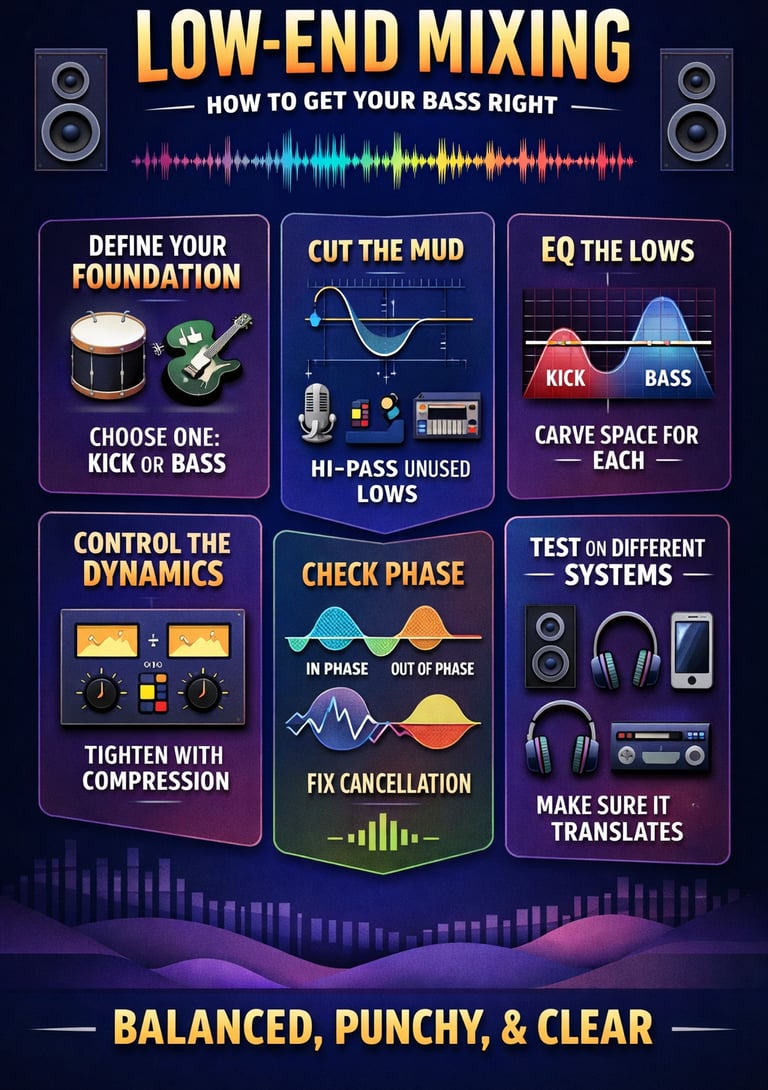
1. Define the foundation: Choose your low‑end anchor
Every track needs one dominant low‑frequency driver: usually the kick or the bass. When both fight for the same space, the mix collapses. Decide early which one leads the groove.
2. Use high pass filters wisely: Clear the clutter
Non‑bass instruments often carry unnecessary rumble. High‑passing guitars, vocals, pads, and FX removes mud and frees headroom.
3. Shape the kick and bass relationship: Carve space, don’t stack
Use EQ to give each element its own lane.
Kicks often live around 50–80 Hz
Bass fundamentals often sit around 60–120 Hz
Overlap is fine — chaos is not.
4. Control dynamics: Keep the low end consistent
Low frequencies carry huge energy swings. Gentle compression or multiband control keeps the bottom tight and predictable.
5. Check phase and polarity : Avoid accidental cancellation
If your kick and bass disappear when played together, phase is the culprit. Aligning waveforms or flipping polarity can restore lost weight instantly.
6. Reference on multiple systems : Translation is everything
A mix that sounds huge on your monitors but collapses on earbuds isn’t ready. Cross‑checking exposes problems early.
How Mastering Brings Out the Low End You’ve Built
Mastering doesn’t “fix” a broken low end — but it can enhance, reveal, and tighten what’s already working. Here’s how.
1. Precision EQ: Micro‑adjustments that reshape the entire mix
A half‑decibel lift at 60 Hz or a subtle cut at 200 Hz can transform the sense of weight and clarity. These moves are tiny but powerful.
2. Harmonic enhancement: Making bass audible on small speakers
Mastering engineers use harmonic tools to add upper‑bass content that translates on phones and laptops without muddying the mix.
3. Low end stereo management: Keeping the bottom tight and mono‑compatible
Below ~120 Hz, stereo width can cause phase issues. Mastering ensures the low end stays focused and punchy across all systems.
4. Dynamic glue: Cohesion without crushing
Mastering compression and limiting can tighten the low end so it feels controlled, powerful, and consistent — without sacrificing punch.
5. Playback translation checks: The final safety net
Professional mastering rooms are designed to reveal the truth. If something is off in the low end, it will show up here and be corrected before release.
The Real Magic: Mix + Mastering Working Together
When the mix has:
A clear low‑end anchor
Controlled dynamics
Clean sub‑bass
No phase issues
Space carved between kick and bass
…mastering can elevate it dramatically. The low end becomes:
Deeper
Tighter
More powerful
More consistent
More translatable across systems
Mastering doesn’t add low end — it reveals it.
Final Thought
Low‑end management is a partnership between mixing and mastering. The mix shapes the foundation; mastering brings it into focus. When both stages work together, your track gains the weight, punch, and clarity that separates amateur releases from professional ones.
Contact Us
Email:
© 2026 Mastering Alliance™