ISRCs Explained: How They Work, Why Re‑Releases Need New Codes, and Best Practices for Labels
Discover how ISRC codes power music identification and royalty tracking. Learn why re‑releases often need new ISRCs, how proper code management protects catalogue integrity, and the best practices every record label should follow for clean metadata and accurate reporting.
Andy De Rosa (Founding Member/Senior Mastering Engineer)
5/21/20265 min read
An ISRC is the unique digital fingerprint of a specific recording. Not the song, not the composition - the recording. Any time that recording meaningfully changes, or is re‑released in a way that constitutes a new product, you typically need a new ISRC.
What an ISRC Actually Is
An International Standard Recording Code (ISRC) is a 12‑character identifier assigned to a single audio or video recording. It’s the industry standard used by:
Streaming platforms
Performing rights organisations
Charts and reporting systems
Broadcasters and radio
Digital distributors
It ensures that every play, sale, sync, or broadcast is attributed to the correct recording.
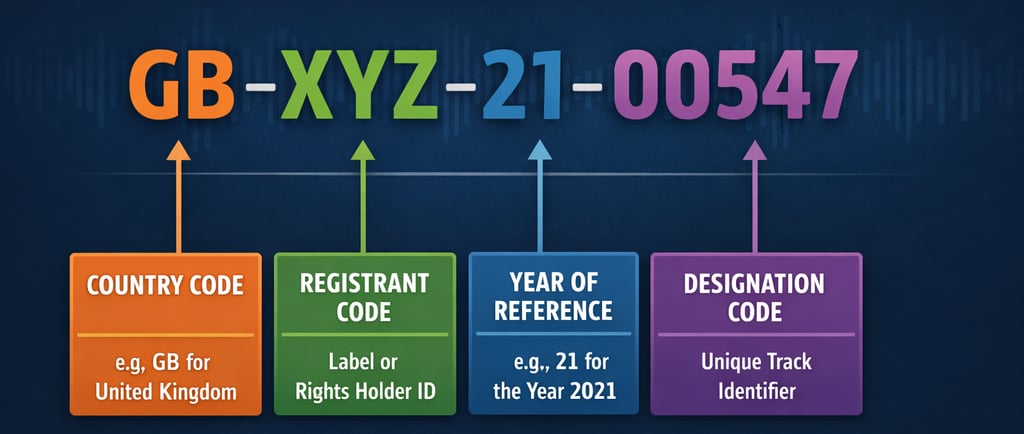
How an ISRC is structured
Country code (e.g., GB)
Registrant code (assigned to the label or rights holder)
Year of reference
Designation code (unique number for each track)
This structure makes each ISRC globally unique and permanently tied to that specific recording.
Music Metadata Explained
Music metadata is the invisible framework that tells digital platforms, rights organizations, and listeners what a recording is, who made it, and how it should be credited. It’s the DNA of your music catalogue - essential for discovery, royalties, and professional presentation.
Core Metadata Fields
Each audio file carries embedded data that defines its identity. The most important fields include:
Track title - The official name of the recording.
Artist name - The performing artist or group.
Album title - The release or collection the track belongs to.
ISRC code - The unique identifier for the recording itself.
ISWC code - The identifier for the composition (songwriting).
Genre - Helps DSPs categorise and recommend music.
Copyright and publisher info - Defines ownership and rights.
Album art - Visual branding embedded in the file.
Why Metadata Matters
Good metadata ensures your music is:
Discoverable – Search engines and streaming algorithms rely on it.
Credited correctly – Royalties flow to the right people.
Professional – Labels, distributors, and broadcasters expect clean metadata.
Future‑proof – Proper tagging keeps your catalogue usable across evolving platforms.
Best Practices
Embed metadata at mastering stage – Don’t wait until distribution*
Use consistent naming conventions – Avoid typos and mismatched titles.
Include ISRC and ISWC codes – They’re critical for tracking and royalties.
Check metadata visibility – Some fields aren’t displayed publicly but still matter.
Keep a metadata sheet – Maintain a master record for every release.
* This is only achievable if the indie artist/label is registered with a ISRC agency in the country of residence. For more information on this topic, please read our FAQ.
In Practice
When you deliver a mastered WAV or AIFF to a label or distributor, the embedded metadata should already include:
Artist, title, album, year, genre
ISRC, copyright, and label name
Artwork and composer credits
That way, your files are broadcast‑ready and royalty‑ready from day one.
ISRCs vs. Songs: Why the Distinction Matters
A common misconception is that an ISRC identifies a song. It doesn’t. It identifies a recording of a song.
That means:
A remaster is a different recording
A remix is a different recording
A live version is a different recording
A radio edit is a different recording
A re‑cut, re‑mixdown, or re‑vocal is a different recording
Each of these requires its own ISRC because they are not the same audio asset.
Why Re‑Releases Often Need a New ISRC
This is where labels frequently get tripped up. The rule of thumb is simple:
If the audio changes, the ISRC changes. If the product changes, the ISRC usually changes.
Here are the most common scenarios.
1. The track has been remastered
Even if the arrangement is identical, a remaster is considered a new recording because the audio has been altered.
New ISRC required.
2. The track has been re‑mixed or re‑edited
Any change to the mix — new balance, new processing, new arrangement, new structure — creates a new recording.
New ISRC required.
3. The track is being re‑released through a new distributor
Some distributors allow you to reuse the original ISRC. Others require a new one. But from a label‑best‑practice standpoint, it’s cleaner to issue a new ISRC because:
It avoids reporting conflicts
It prevents catalogue duplication
It keeps analytics clean
It avoids mismatched metadata across DSPs
Often a new ISRC is recommended.
4. The track is part of a new product (e.g., deluxe edition, anniversary edition)
If the audio is identical, you can reuse the ISRC — but many labels choose not to, because:
It separates the new release cycle
It avoids cannibalizing old analytics
It keeps catalogue management cleaner
It allows DSPs to treat the release as new content
New ISRC recommended for product clarity.
5. The track has been re‑uploaded after takedown
If the audio is unchanged, you may reuse the ISRC. But if the release strategy has changed (new artwork, new metadata, new marketing cycle), many labels issue a new ISRC to avoid legacy data conflicts.
Case‑by‑case, but new ISRC is often cleaner.
Why ISRC Integrity Matters for Labels
For labels, ISRC discipline is not optional — it’s a core part of catalogue management.
1. Accurate royalty reporting
Every DSP, PRO, and reporting system uses ISRCs as the primary identifier. If you reuse codes incorrectly, you risk:
Misallocated royalties
Lost revenue
Conflicting reporting
Catalogue contamination
2. Clean analytics
A reused ISRC can merge data from different versions of a track, making it impossible to:
Track campaign performance
Measure growth
Compare versions
Analyse remaster impact
3. Avoiding DSP conflicts
Platforms like Spotify, Apple Music, and YouTube Music rely heavily on ISRCs. Incorrect reuse can cause:
Wrong audio being linked
Incorrect artist pages
Duplicate releases
Metadata mismatches
4. Long‑term catalogue value
A well‑managed catalogue is an asset. Clean ISRC usage ensures:
Accurate historical data
Clean royalty trails
Higher valuation for catalogue sales
Better interoperability with future systems
Best Practices for Labels
Here’s the gold‑standard approach used by organised labels and rights holders.
Maintain a central ISRC registry
Keep a master spreadsheet or database with:
ISRC
Track title
Version (original, remaster, radio edit, etc.)
Release date
Distributor
Notes on changes
Assign ISRCs early in the process
Ideally at the mastering stage - not at distribution.
Never reuse an ISRC for a different recording
Even if the difference seems small.
Document every version of every track
This prevents confusion years later when the catalogue grows.
Use consistent naming conventions
E.g.,
Song Title (2026 Remaster)
Song Title (Radio Edit)
Song Title (Extended Mix)
Coordinate ISRCs with mastering engineers
Provide codes before WAVs are finalised so they can be embedded correctly.
Keep ISRCs separate from UPCs
One identifies the recording; the other identifies the product.
When You Don’t Need a New ISRC
There are a few exceptions.
1. Re‑uploading the exact same audio after a takedown
If the audio is identical and the release is identical, you can reuse the ISRC.
2. The loudness of the song changes but everything else is the same
If a song is included in a compilation and as part of that release the audio file's loudness changes to align with the overall compilation loudness, this is usually an exception that is allowed. Please be clear that this does not include any re-mastering - it only applied to the overall audio volume of the file.
3. Changing artwork or metadata only
If the audio is unchanged, the ISRC stays the same.
4. Moving a release between distributors (if audio is unchanged)
Some distributors allow this. But again - many labels still prefer a new ISRC for clarity.
Final Thoughts
For labels, ISRCs are more than just codes — they’re the backbone of catalogue integrity, royalty accuracy, and long‑term asset value. Treat them with the same care you give to masters, metadata, and contracts.
Contact Us
Email:
© 2026 Mastering Alliance™