Ceiling, Overs & True Peak: Myths vs Truths Across Digital, CD & Vinyl
A clear, myth‑busting guide to ceiling, sample peaks, true peaks and overs across digital, CD and vinyl formats. Learn why streaming needs –1.0 dBTP, why CDs still overshoot, why vinyl requires lower peaks, and how proper format‑specific mastering prevents distortion, codec artefacts and translation issues. Essential reading for artists, producers and labels who want clean, professional, release‑ready masters.
Andy De Rosa (Founding Member/Senior Mastering Engineer)
6/9/20263 min read


Most of the confusion around loudness and distortion comes from one thing: people don’t understand what a “peak” actually is.
Digital, CD, and vinyl all respond differently to peaks - and if you use the wrong ceiling for the wrong format, you get distortion, overs, and translation problems.
This post breaks down the myths, the truths, and the real‑world numbers you should be aiming for.
1. Sample Peaks vs True Peaks - The Core Misunderstanding
What people think peaks are
Most producers assume that the highest point on their DAW’s waveform - the sample peak - is the actual loudest point in the audio.
That’s not how digital audio works.
What peaks actually are
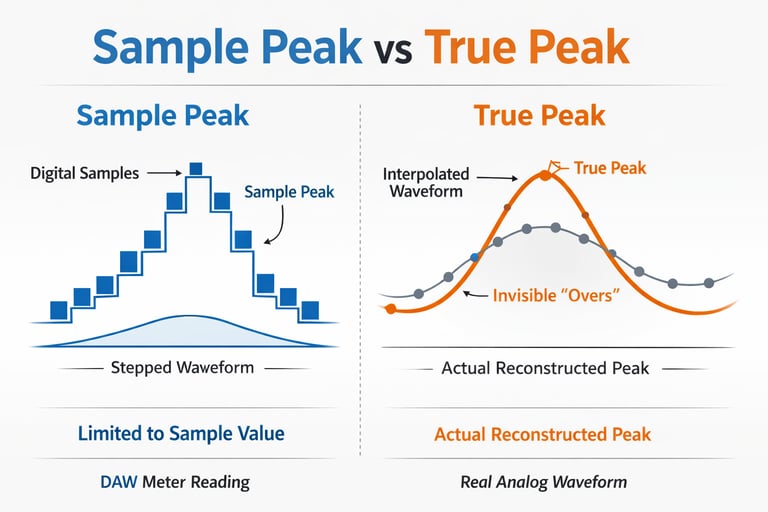
Digital audio is made of discrete samples, but playback systems reconstruct a continuous waveform between those samples. This reconstructed waveform can exceed the highest sample value.
That reconstructed maximum is the true peak.
Sample Peak
The highest value of the digital samples
What most DAWs show by default
Does not reflect the real reconstructed waveform
Can look “safe” while still clipping on playback
True Peak
The highest point of the reconstructed analogue waveform
Measured using oversampling (4×, 8×, 16×)
Can exceed sample peaks by +0.5 to +1.5 dB
What streaming platforms measure
What causes codec distortion if not controlled
Why this matters
A file that reads –0.1 dBFS sample peak can easily reconstruct to +1.0 dBTP, causing:
harshness
brittle transients
distortion after encoding
overs on consumer DACs
This is why mastering engineers rely on true‑peak limiters, not sample‑peak limiters.
2. Overs: What They Really Are
The myth
“Overs mean clipping.”
The truth
Overs are inter-sample peaks - points where the reconstructed waveform exceeds 0 dBFS even though no individual sample does.
They are invisible unless you use a true‑peak meter.
Overs are the reason your mix can sound clean in the DAW but distort on:
Spotify
Apple Music
YouTube
Bluetooth speakers
Car stereos
Older CD players
Overs are not a “producer problem”. They’re a format‑translation problem.
3. Digital Streaming: The True‑Peak Battlefield
The myth
“As long as I don’t hit 0 dBFS, I’m safe.”
The truth
Streaming platforms re‑encode your audio. Lossy codecs (AAC, MP3, Ogg) increase true peaks.
A master at –0.1 dBFS can easily become +1.5 dBTP after encoding.
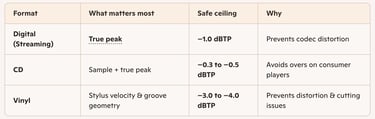
Safe ceiling for digital
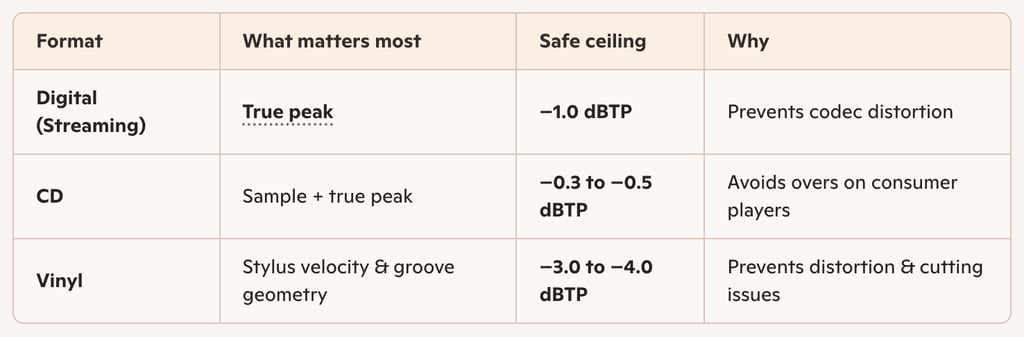
–1.0 dBTP This is the widely accepted standard for streaming.*
If you want to go deeper into this, here is a succinct explanation of codec distortion:
When your audio is encoded into a lossy format like MP3, AAC, or Ogg Vorbis, the codec doesn’t just compress data - it reconstructs the waveform using psychoacoustic models. During this process, the codec can alter transient shapes and overshoot peaks, creating distortion that wasn’t in your original master.
* There are varying opinions on this value, but my perspective is grounded in extensive professional experimentation and in lessons learned from some of the most respected, award‑winning mastering engineers in the business.
4. CD Audio: Not Immune to Overs
The myth
“CD doesn’t need true‑peak limiting.”
The truth
CD players reconstruct audio differently from DAWs. A CD master at –0.1 dBFS can still overshoot to +0.8 dBTP on playback. This is true for many older CD players or those of poorer build quality.
Safe ceiling for CD
–0.3 to –0.5 dBTP
This keeps the master competitive while avoiding playback distortion.
5. Vinyl: Peaks Behave Differently Entirely
The myth
“You can master vinyl at the same ceiling as digital.”
The truth
Vinyl doesn’t care about true peak. It cares about:
stylus velocity
groove width
HF modulation
side length
vertical vs lateral movement
High peaks - especially HF transients - cause:
groove distortion
sibilant tearing
cutting‑head stress
skipping on consumer turntables
Safe ceiling for vinyl
For most projects: –3.0 dBTP
For bright, transient‑heavy, or long sides: –3.5 to –4.0 dBTP
This is why vinyl masters are always delivered separately.*
*You’ll hear a range of opinions on vinyl guidelines, but one thing is certain: you cannot use the same master created for digital or CD and expect it to translate well on vinyl. The format simply can’t handle those extremes, and it needs to be approached with the respect it deserves.
6. Why Different Formats Need Different Ceilings
The Big Takeaway
A ceiling isn’t just a number. It’s a translation strategy.
Understanding sample peaks vs true peaks is the foundation of clean, professional, format‑specific mastering.
This is why us engineers at Mastering Alliance™ deliver:
streaming‑safe digital masters
CD‑ready masters
vinyl‑optimised masters
and format‑specific QC to prevent overs, distortion, and translation issues
Your music deserves to sound right everywhere — not just in your DAW. Get in touch today!
Contact Us
Email:
© 2026 Mastering Alliance™